dbm — a database monitoring CLI in Go
A small tool I built in 2023 to answer one recurring question: which replica is the master right now?
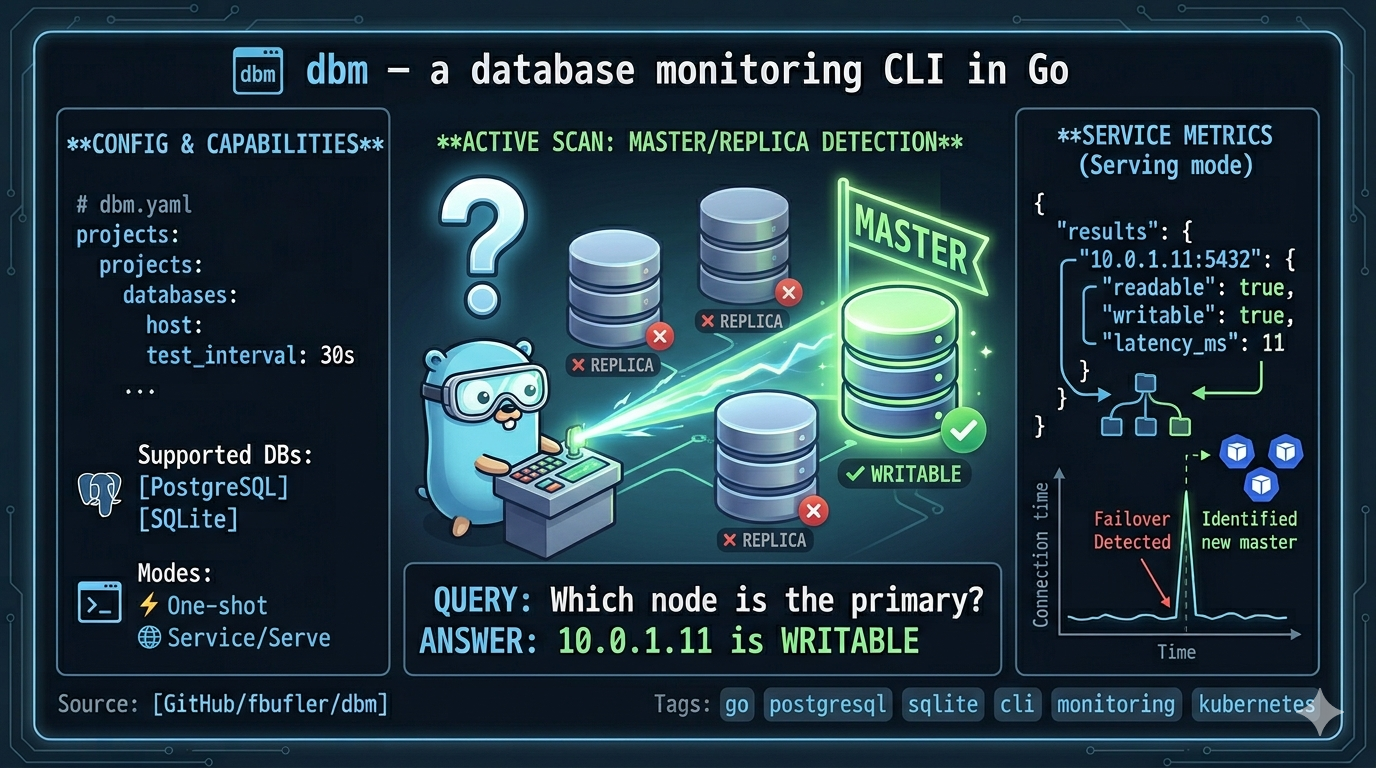
In late 2023, my team and I faced a recurring challenge: managing multiple database instances without a streamlined way to distinguish between primary masters and read-only replicas. At the time, our infrastructure was hosted on-premises via Cloud Foundry, a setup that lacked native support for automatic master detection or seamless connection failover.
The result was a brittle, manual switchover process during database failures. To bridge this gap, I proactively developed a proof-of-concept tool to automate health checks, which I later refactored and integrated natively into Kubernetes for production use.
This tool is dbm.
The Challenge
When operating a PostgreSQL cluster with a primary-replica architecture, three critical questions arise constantly:
- Identification: Which host is currently the primary (master) node?
- State: Is the instance currently accepting write operations?
- Performance: What is the connection latency across the entire fleet?
While these metrics can be checked manually, doing so at scale is inefficient and error-prone during a high-pressure incident.
Solution: How dbm Works
dbm is a lightweight CLI tool written in Go that executes connectivity and read/write health checks against a defined list of database instances.
Users define their infrastructure in a simple yaml configuration:
test_timeout: 5
test_interval: 30
databases:
  - host: localhost
    port: 5432
    username: postgres
    database: postgres
    connection_timeout: 5
  - host: localhost
    port: 5433
    username: postgres
    database: postgres
    connection_timeout: 5
The tool offers two modes of operation:
- One-shot Mode: Use
dbm localfor a quick status report in the terminal. - Service Mode: Use
dbm serveto expose real-time health data as a JSON endpoint, ideal for integration with monitoring dashboards or Kubernetes liveness probes.
Example JSON Output:
{
  "results": {
    "localhost:5432/postgres": {
      "connectable": true,
      "connection_time": 81034,
      "writable": true,
      "readable": true
    },
    "localhost:5433/postgres": {
      "connectable": true,
      "connection_time": 248551,
      "writable": false,
      "readable": true
    }
  }
}
The writable flag is the most critical metric here—providing immediate confirmation of which node is the primary.
Expanded Capabilities: SQLite Support
I eventually implemented SQLite support to facilitate local development and allow integration tests to run without the overhead of a full PostgreSQL instance. This expanded the tool’s utility to include local database auditing within the same workflow.
Retrospective
Looking back, dbm was a highly effective solution for the specific infrastructure constraints we faced. While the codebase reflects its origins as a rapid "scratchpad" project—utilizing plaintext configurations and hardcoded test table names—it successfully automated a critical manual process.
More importantly, it served as an excellent exercise in building robust CLIs in Go, implementing YAML configuration parsing, and designing automated integration test suites.
View the Source: GitHub - fbufler/dbm